Artificial intelligence is rapidly reshaping legislative drafting. Across governments and parliaments, AI tools are increasingly used to assist with formatting, cross-referencing, linguistic consistency, and procedural compliance. The gains in speed and consistency are real. But the substantive knowledge required to determine whether a law is complete, enforceable, and informed by relevant international practice remains lacking.
Where current AI tools fall short
In practice, gaps in draft legislation tend to follow recurring patterns. Key elements, such as monitoring frameworks, enforcement mechanisms, and sufficiently precise legal definitions, are often underdeveloped or absent.
Not because drafters are inattentive, but because knowing what a complete regulatory regime in a given area looks like — across sectors, across borders — requires a breadth of knowledge that no small team, however attentive, can reasonably be expected to carry under time pressure.
Current tools do not help with this. A bill can satisfy every check a legislative AI tool runs on it and still be substantively deficient; silent on how comparable jurisdictions have addressed the same regulatory challenge, missing the provisions that would make it enforceable, incomplete in ways that only become visible after enactment. These are not errors that consistency checking catches. They require a different kind of knowledge and a different kind of reference material.
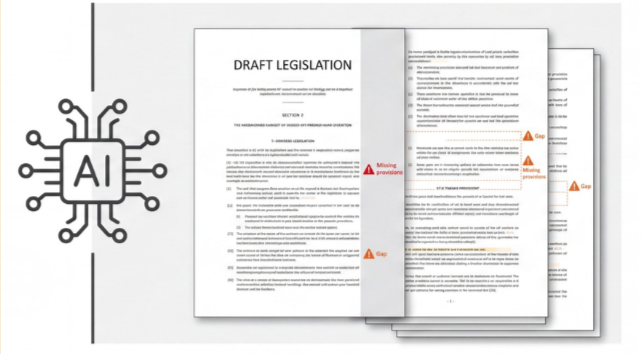
That material is largely absent from the corpora that current tools rely on. Rich in procedural guidance, thin on substantive regulatory knowledge, those corpora reflect what was easy to assemble, not what drafters most need. The result is tools that have raised the floor on legislative form without raising it on legislative substance.
What changes with the right knowledge base
The Regulatory Institute has developed a curated set of LLM-ready reference materials designed for direct integration into RAG pipelines, fine-tuning corpora, or system-level prompts. Section C of our dedicated subsite sets out the specific documents recommended for inclusion in a default regulatory reference corpus.
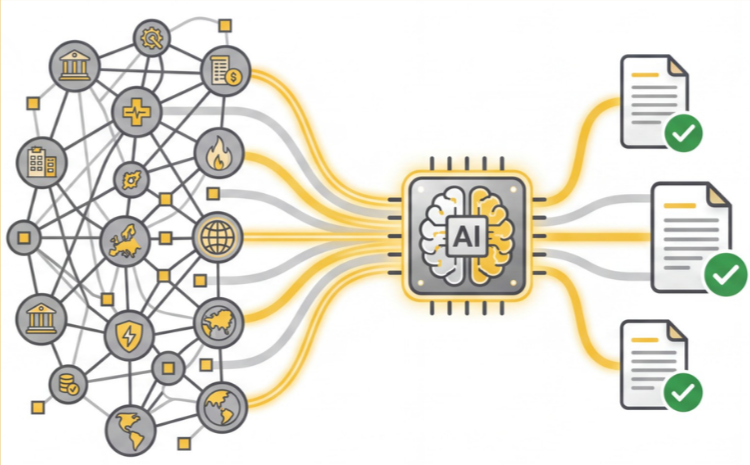
With this material integrated, AI systems can identify missing regulatory components rather than only verifying those present. They can support completeness checks against established regulatory practice and bring comparative international frameworks into the drafting workflow, not as a separate research task, but as a default capability. They can generate richer substantive content from the outset of the drafting process, ensuring better and more even implementation later-on.
The underlying knowledge base spans more than 100 sectors and 80 jurisdictions, compiled by legislative and regulatory practitioners. It is model-agnostic and requires no proprietary tooling; the materials are structured for straightforward ingestion into standard AI workflows. Additional resources are in development, including a dedicated toolbox for Commonwealth and Latin American legislators, alongside the existing EU Legislators’ Toolbox.
The gap that remains
AI has genuine potential to improve the quality of legislation, not merely the efficiency of its production. Realising that potential means engaging with substance, not only form. The knowledge resources to make that possible now exist. What they need is integration.